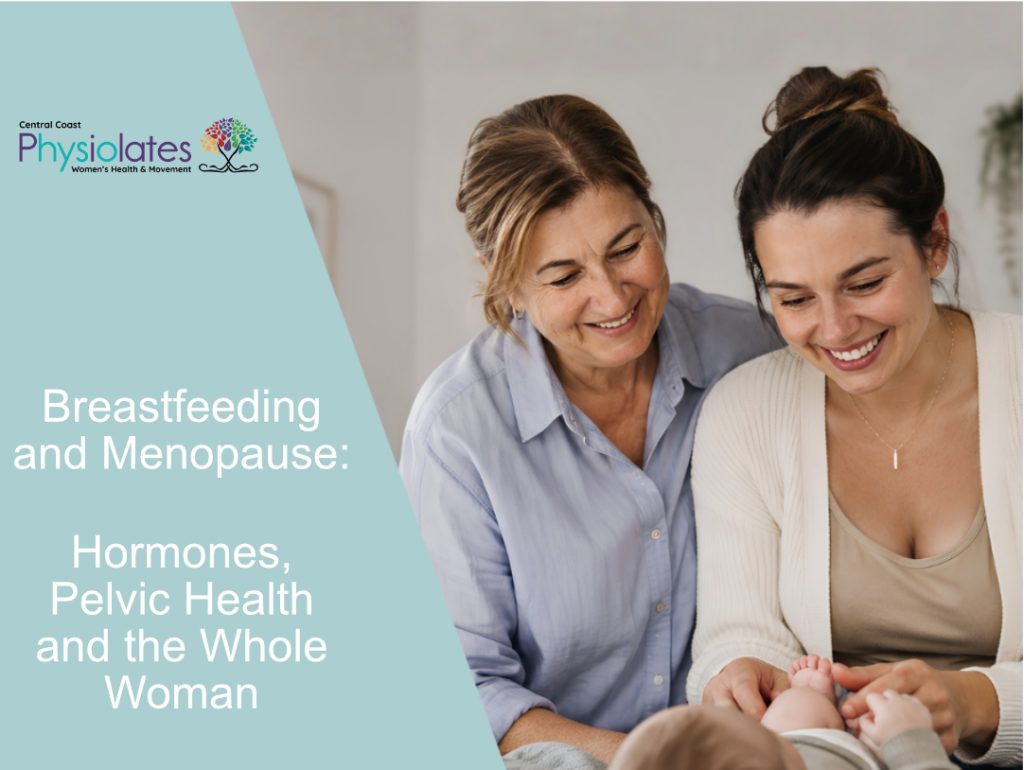
Breastfeeding and menopause are very different stages of life, but women can experience some surprisingly similar changes during both.
You may notice:
-
Vaginal dryness, irritation or changes in lubrication
-
Pain or discomfort with intercourse
-
Bladder urgency, frequency, leakage or recurrent UTIs
-
Changes in bowel function
-
Changes in libido
-
Poor sleep, mood changes or anxiety
-
Brain fog or difficulty concentrating
-
Changes in muscle strength, recovery or how your body feels when you move
|
Part of the reason is hormones — but hormones aren’t the full picture. |
During breastfeeding, prolactin can suppress ovulation, meaning oestrogen remains lower and you don’t get the normal rise in progesterone that occurs after ovulation.
During perimenopause, ovulation becomes less predictable, progesterone becomes more variable and oestrogen can fluctuate considerably before eventually remaining lower after menopause.
These hormonal changes can influence your brain, vaginal and urinary tissues, bones and muscles. But what you experience also depends on how those changes interact with your tissue health, blood flow, nerve and muscle function, sleep, mental health, bowel health, movement and the physical demands on your body.
So we need to understand what your hormones are doing and how they interact with the rest of your body’s needs and function.
| 1 |
Vaginal Health — And Why pH Matters |
Oestrogen helps maintain healthy vaginal and vulval tissues and supports the protective Lactobacillus bacteria that help keep the vagina naturally acidic.
When oestrogen falls, vaginal tissues can become thinner and drier, Lactobacillus may reduce and vaginal pH can rise.
We commonly associate these changes with Genitourinary Syndrome of Menopause (GSM). More recently, researchers have begun looking at similar changes specifically through a breastfeeding lens, with the term Genitourinary Syndrome of Lactation (GSL) proposed.
The terminology is new. The symptoms aren’t.
Vaginal Oestrogen + Physiotherapy
Vaginal oestrogen has been used for many years to support vaginal and vulval tissue health when oestrogen is low, including postpartum for tissue health, dryness, painful intercourse and problems around perineal tears and episiotomy scars.
But tissue health may only be one part of the problem.
Pelvic floor muscles may also be weak, overactive, painful or poorly coordinated. A muscle can be both weak and held in a protective high resting state, affecting contraction and relaxation and contributing to altered local circulation and pain. Pregnancy and birth can also affect nerve function, sensation and muscle recruitment.
This is why vaginal oestrogen and physiotherapy can work alongside each other.
Local vaginal oestrogen, such as Vagifem, can support the oestrogen-responsive tissues, while physiotherapy can work on relaxation, strength, coordination, circulation, scars, pain and muscle function.
Your GP or obstetrician guides whether vaginal oestrogen is appropriate for you, including the preparation, prescription and dosage. At CCPL, we can assess and treat the functional pieces alongside it.
| 2 |
Brain, Mood and Sleep |
Oestrogen and progesterone also interact with the brain and nervous system.
Progesterone produces neuroactive metabolites, including allopregnanolone, which interact with the brain’s GABA system involved in calming and regulation.
After birth, progesterone falls dramatically and may remain relatively low while breastfeeding suppresses ovulation. During perimenopause, progesterone becomes more variable while oestrogen can fluctuate significantly.
This is one reason sleep, mood, anxiety, concentration and mental clarity deserve to be part of the conversation.
Movement and exercise can support mood, sleep, cognition and nervous system regulation, but sometimes symptoms need more investigation.
Hormonal transitions may also make existing ADHD symptoms feel more noticeable or harder to manage, particularly when combined with poor sleep, stress and the increased mental load of a new baby or midlife.
If changes in mood, anxiety, fatigue, concentration or sleep feel significant or out of control, talk to your GP. There may be other contributors worth investigating, including iron, B12 or folate deficiency, thyroid function or other medical issues. Some women also choose to work with a dietitian or naturopath for additional nutritional support.
The important thing is not to dismiss significant changes as simply “postpartum” or “menopause.”
| 3 |
Your Bowel Is Part of Pelvic Health |
There is growing research into reproductive hormones and the gut microbiome, although we’re still learning what that means clinically.
What we already know is that constipation and repeated straining increase pressure through the pelvic floor.
Food, fibre, fluids, medications and movement can all influence bowel function. That’s why at CCPL we ask about your bladder and your bowel — and involve your GP, dietitian or other appropriate practitioner when more support is needed.
| 4 |
Bone, Muscle and Movement |
Breastfeeding and menopause can both affect bone density, but differently.
During breastfeeding, bone mineral density can temporarily reduce as the mother’s body helps meet the calcium demands of breast milk. For most healthy women, much of this is recovered as breastfeeding reduces and ovarian function returns.
After menopause, persistently lower oestrogen contributes to ongoing bone loss and increasing osteoporosis risk.
Bone needs load. Muscle needs load too.
Resistance and appropriate weight-bearing exercise can support bone while building muscle, strength and balance.
After pregnancy, that may mean rebuilding your capacity to lift, carry, run and exercise. During and after menopause, maintaining muscle, bone and physical capacity becomes increasingly important.
| 5 |
A Stronger Squeeze Isn’t Always the Answer |
After pregnancy and birth, many women become incredibly good at compensating.
Your body finds another way to get the job done — perhaps using more abdominal pressure, gripping other muscles or changing your breathing instead of recruiting the pelvic floor effectively within movement.
Simply doing more squeezes, following a generic online pelvic floor program or using a pelvic floor gadget isn’t necessarily the answer.
Are you actually recruiting your pelvic floor? Are other muscles doing the work? Are you increasing downward pressure? Can the pelvic floor relax afterwards? And can it respond automatically when you cough, lift, run or move?
You can become very good at squeezing without improving how your pelvic floor functions as part of your body.
This is why movement education matters.
At CCPL, we assess what your body is doing and retrain the pelvic floor alongside breathing, strength and whole-body movement.
Our physiotherapist-led group therapy gives you more time practising movement in front of your physio, with correction and progression, while reducing the cost of ongoing rehabilitation.
|
The goal isn’t simply a stronger squeeze. It’s a pelvic floor that works with your body automatically when you need it. |
Looking at All of You
At Central Coast Physiolates Women’s Health & Movement, we know physiotherapy is only one part of women’s healthcare.
That’s why we have built a multidisciplinary team to help bridge the gaps between different areas of healthcare rather than looking at one symptom or body system in isolation.
Your symptoms may involve hormones, tissues, pelvic floor function, movement, bone, bowel health, sleep or mental health — sometimes several at once.
At CCPL, our team brings together Women’s Health, musculoskeletal and sports physiotherapy, Exercise Physiology, Occupational Therapy, Psychology, Osteopathy, remedial massage and lymphatic care, while working alongside your GP, obstetrician and other medical specialists when needed.
You don’t need every profession.
|
You need the right people looking at the right things. If something doesn’t feel right, you don’t have to simply assume it’s your hormones. Come and talk to our team. We can help you work out where to start. |
If you’re breastfeeding, postpartum, moving through perimenopause or menopause and something doesn’t feel right, don’t simply assume “it’s my hormones.”
We want to understand what your hormones are doing, how they are interacting with the rest of your body’s needs and function, and what we can do to help.
This information is for general education and does not replace individual medical advice. Prescription medications, including vaginal oestrogen, should be discussed with your GP, obstetrician or other appropriate medical practitioner.